





 Contact
 Log in
Turn-key Passive Income
1031 Exchange
As experienced multifamily real estate owner-operators, we deliver exclusive 1031 exchange solutions for a seamless, turn-key investment experience.
What is a 1031 Exchange?
Named for Internal Revenue Code Section 1031, this provision allows real estate investors to defer capital gains taxes when selling one investment property by reinvesting the proceeds into another like-kind property. If you advise clients, please visit our 1031 Exchange page for professionals.
Key Requirements for a 1031 Exchange
To successfully execute a 1031 exchange, specific conditions must be met.
- Like-Kind Property. The property being sold and the property being acquired in a 1031 exchange needs to be “like-kind,” meaning both are held for business or investment purposes. Personal-use properties, such as primary residences, do not qualify for 1031 exchanges.
- Qualified Intermediary. The proceeds from the sale must be held in escrow by a third party between the transactions. Important: This needs to be set up before the sale of the property is completed.
- Timelines. The seller must identify a replacement property, with the option to designate up to two additional backup properties, within 45 days of the sale and close on it within 180 days of the sale.
Benefits of a 1031 Exchange

Defer capital gains taxes by via reinvesting in a like-kind property.

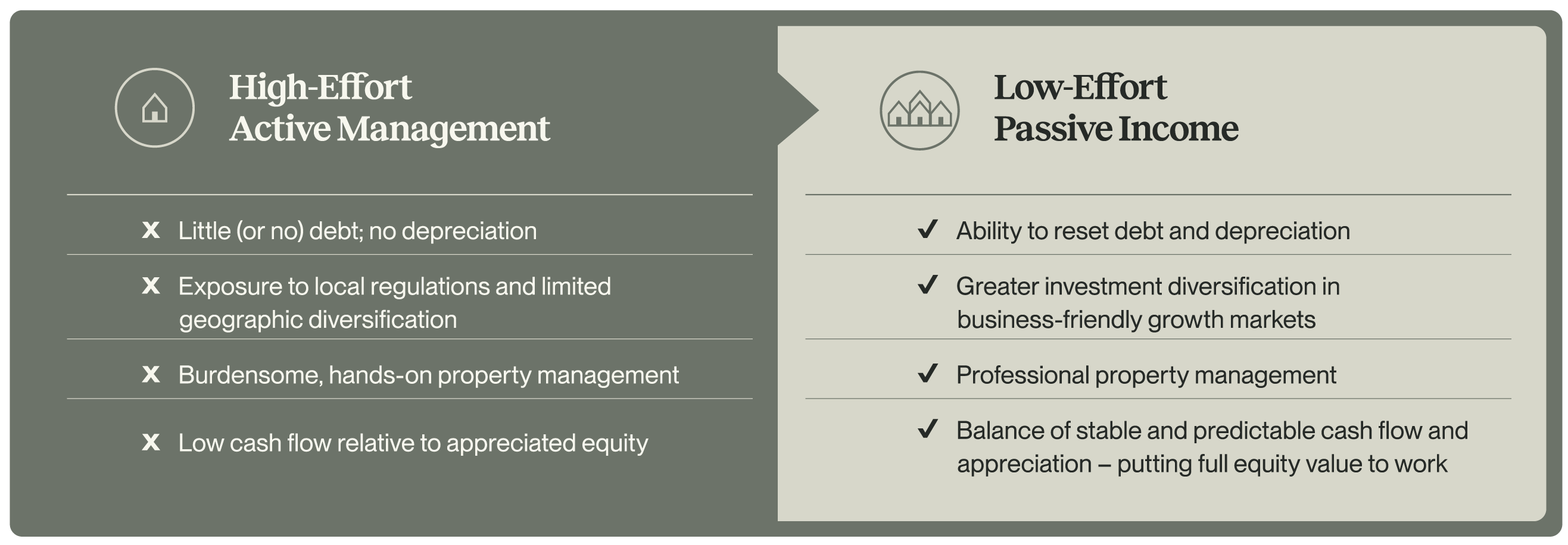
Convert active real estate management to passive, hassle-free income.

Diversify your real estate portfolio across regions and asset classes.

Optimize long-term gains with an increased cost basis and maximized depreciation deductions.
Springfield Apartments — Murfreesboro, TN


Move from Active Management to Receiving Passive Income
How to Work with Us
Our team will walk you through every step of the 1031 exchange process.
1

Contact Hamilton Zanze early in your sales process to understand your reinvestment options. Federal guidelines require investors to identify a replacement property within 45 days of closing and complete the exchange within 180 days. Engaging early gives you the time and options needed to make a sound reinvestment decision.
2

Complete the sale of your investment property and transfer proceeds to a third-party exchange accommodator.
Hamilton Zanze is not a Qualified Intermediary (QI) or exchange accommodator. Our team can connect you with preferred QI partners to help facilitate your exchange process.
3

Review and select your curated reinvestment options with Hamilton Zanze.
4

Enjoy the benefits of your passive real estate investment.
Get Started Today
With more than 25 years of experience and over 500 completed exchanges since 2022 alone, Hamilton Zanze can help clarify whether a tax-deferred exchange aligns with your investment goals. Contact us early in your sale process to make the most of your exchange.
Educational Guide:
Unlocking the Benefits of a 1031 Exchange
This educational guide helps rental property owners navigate selling their investment properties, avoid common pitfalls, and successfully execute a 1031 exchange with a trusted partner like Hamilton Zanze.

The Role of a 1031 Exchange in Real Estate Investing

1031 Exchange FAQs
How early should I start planning a 1031 exchange?
Ideally, planning begins when you first consider selling your property. Identifying reinvestment options early provides greater flexibility and helps reduce execution risk around IRS timelines.
What role does Hamilton Zanze play in a 1031 exchange?
We provide access to institutional-quality multifamily investment designed to align with 1031 exchange requirements and long-term investment objectives. We work alongside your qualified intermediary and advisors throughout the process — we do not provide tax or legal advice.
Can a 1031 exchange reduce active property management responsibilities?
Yes. Many investors use a 1031 exchange to transition from direct ownership into professionally managed assets with a qualified sponsor, allowing continued real estate exposure without the demands of day-to-day management.
What happens if I miss a 1031 exchange deadline?
Missing identification or closing deadlines may disqualify the exchange and trigger capital gains taxes. That is why early coordination with an experienced sponsor is critical.
Is a a 1031 exchange suitable for long-term investors?
A 1031 exchange is commonly used by investors with a long-term perspective who want to keep capital invested, defer taxes, and build diversification within their real estate portfolios.
